

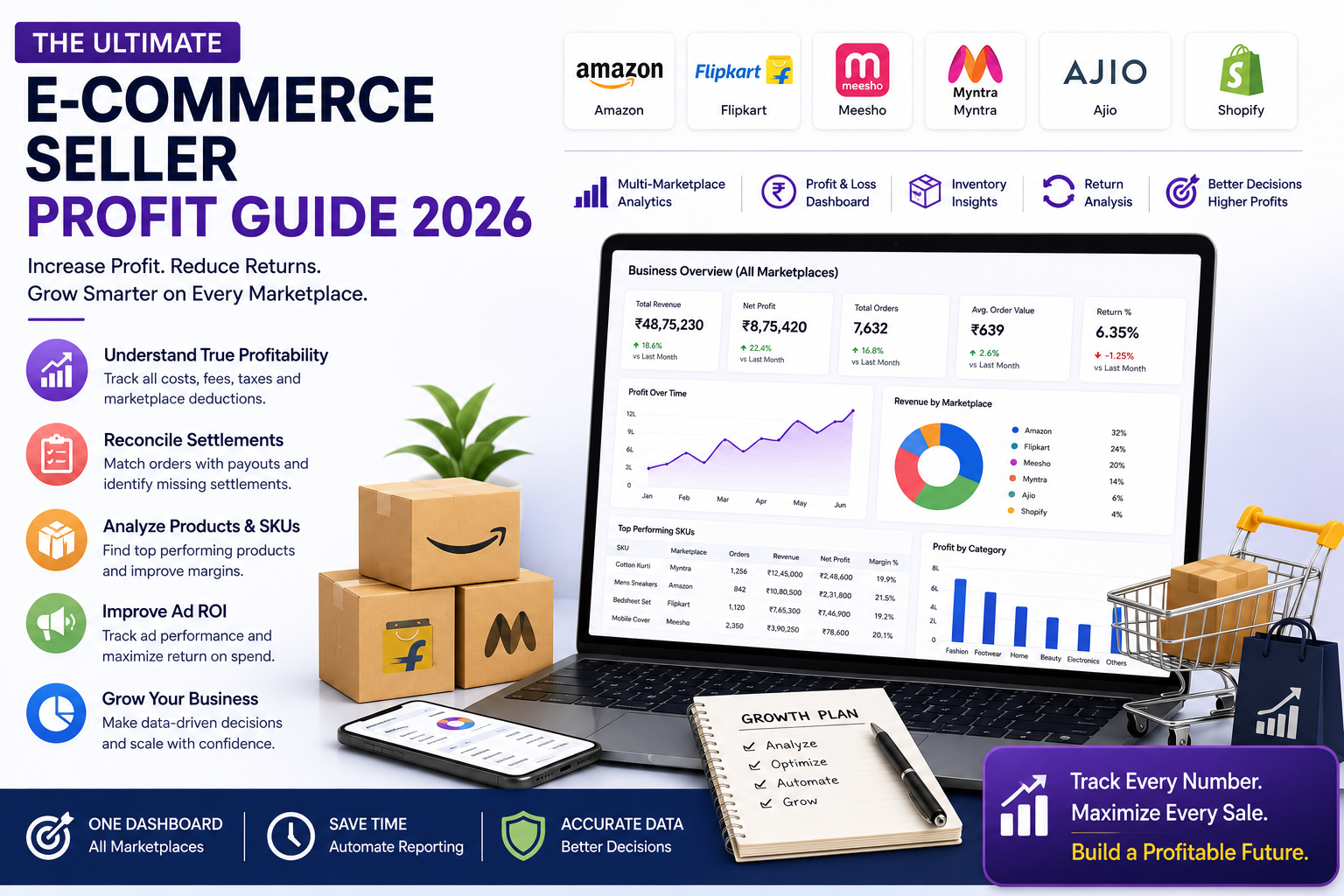
India's e-commerce industry is growing at an incredible pace. Millions of customers now shop online through marketplaces such as Amazon, Flipkart, Meesho, Myntra, Ajio, Nykaa, and independent Shopify stores.
For sellers, this creates enormous opportunities—but it also introduces new challenges.
Many businesses focus on increasing sales while overlooking the one metric that truly matters:
Profit.
Generating ₹10 lakh in monthly sales is impressive—but if your expenses consume most of that revenue, your business will struggle to grow.
Successful sellers don't just chase more orders. They understand their numbers, analyze their costs, and make decisions based on data.
This guide explains how to increase profitability across every major e-commerce marketplace.
Why Revenue Is Not the Same as Profit
Many sellers proudly say:
"We sold ₹20 lakh this month."
But the real question is:
"How much profit did you actually earn?"
Revenue alone doesn't reflect business health.
Your actual earnings depend on:
- Product Cost
- Packaging Cost
- Shipping Charges
- Marketplace Commission
- Payment Collection Fees
- Advertisement Spend
- Return & Replacement Cost
- Reverse Logistics
- Taxes (GST, TDS, TCS)
- Operational Expenses
Understanding these costs is the first step toward building a sustainable e-commerce business.
Every Marketplace Has Different Charges
Although all marketplaces help sellers reach customers, each platform follows a different fee structure.
Amazon
Typically includes:
- Referral Fees
- Closing Fees
- Fulfilment Charges
- Storage Fees
- Advertising Cost
Amazon provides excellent reach but requires careful fee analysis.
Flipkart
Common charges include:
- Commission
- Fixed Fee
- Collection Fee
- Shipping Charges
- Reverse Logistics
- Advertising
Settlement reconciliation is essential to understand your actual earnings.
Meesho
Meesho sellers should regularly monitor:
- Shipping Adjustments
- Return Recoveries
- Compensation
- Tax Deductions
- Settlement Reports
Profit analysis helps identify products that truly contribute to business growth.
Myntra
Fashion sellers face unique challenges:
- Higher return rates
- Size exchanges
- Seasonal inventory
- Promotional discounts
- Brand campaigns
Monitoring return percentage and SKU performance is especially important.
Ajio
Fashion-focused sellers should analyze:
- Promotional deductions
- Inventory ageing
- Return trends
- Product-wise margins
Shopify
Unlike marketplaces, Shopify gives sellers greater control over pricing and branding.
However, businesses still need to monitor:
- Marketing ROI
- Payment Gateway Charges
- Shipping Costs
- Inventory Management
- Customer Acquisition Cost
Common Hidden Costs That Reduce Profit
Many sellers underestimate operational expenses.
Typical hidden costs include:
Product Cost
Purchase or manufacturing cost.
Packaging
Boxes, courier bags, labels, tape, inserts, and branding materials.
Advertising
Marketplace ads, Google Ads, Meta Ads, influencer campaigns, and promotions.
Returns
Reverse logistics, damaged products, inspection, repackaging, and inventory loss.
Inventory Holding
Slow-moving stock blocks capital and increases storage costs.
Ignoring these costs often leads to incorrect pricing decisions.
Why SKU-Level Profit Analysis Is Essential
Not every product contributes equally to profit.
Example:
|
Product |
Orders |
Revenue |
Net Profit |
|
Women's Kurti |
900 |
₹8,50,000 |
₹1,30,000 |
|
Mobile Cover |
1,800 |
₹9,20,000 |
₹78,000 |
|
Bedsheet |
500 |
₹4,10,000 |
₹92,000 |
|
Sports Shoes |
300 |
₹6,20,000 |
₹1,40,000 |
Revenue doesn't always indicate profitability.
Track:
- Profit Per SKU
- Return %
- Gross Margin
- Advertisement Cost
- Inventory Turnover
SKU analytics helps prioritize products that generate sustainable profits.
Settlement Reconciliation Explained
Settlement reconciliation means matching your orders with marketplace payments.
Benefits include:
- Detecting missing settlements
- Verifying deductions
- Identifying pending claims
- Confirming tax deductions
- Simplifying accounting
- Improving cash-flow visibility
Without reconciliation, revenue leakage can go unnoticed for months.
Reduce Returns to Increase Profit
Returns are among the biggest challenges for online sellers.
High return rates increase:
- Shipping expenses
- Reverse logistics
- Product damage
- Customer support costs
- Inventory losses
To reduce returns:
- Provide accurate product descriptions.
- Use high-quality images.
- Include detailed size charts where applicable.
- Improve packaging.
- Perform quality checks before dispatch.
Reducing returns by even a few percentage points can significantly improve profitability.
Price Products for Profit, Not Just Sales
Many sellers copy competitor pricing.
Instead, calculate your price after considering:
- Product Cost
- Packaging
- Marketplace Fees
- Taxes
- Advertising
- Shipping
- Return Risk
- Desired Profit Margin
A profitable pricing strategy supports long-term growth.
Build an E-commerce Dashboard
A modern dashboard should include:
Sales Overview
- Revenue
- Orders
- Average Order Value
- Sales Trend
Financial Overview
- Net Profit
- Gross Margin
- Marketplace Fees
- Advertisement Cost
- Packaging Cost
Product Performance
- Best Selling SKU
- Highest Profit SKU
- Low Margin Products
- Return Percentage
Settlement Summary
- Settlements Received
- Pending Payments
- Deductions
- Recoveries
Tax Summary
- GST
- TDS
- TCS
The Power of Business Analytics
Data-driven sellers make faster and smarter decisions.
Analytics helps answer questions such as:
- Which marketplace is most profitable?
- Which products should receive more inventory?
- Which advertisements generate the best ROI?
- Which categories deserve expansion?
- Which products should be discontinued?
Instead of relying on assumptions, successful sellers rely on measurable insights.
Why Manual Excel Reporting Is No Longer Enough
As businesses grow, managing reports manually becomes increasingly difficult.
Most sellers need to analyze:
- Settlement Reports
- Order Reports
- Advertisement Reports
- Inventory Reports
- GST Reports
- Tax Reports
Automation reduces errors and saves valuable time.
How Profecom Helps E-commerce Sellers
Profecom is built specifically for Indian marketplace sellers.
Our platform transforms complex reports into simple, actionable dashboards.
Core Features
- Marketplace Settlement Analysis
- Profit & Loss Dashboard
- SKU Profitability
- Return Analysis
- Advertisement ROI
- Inventory Insights
- GST Summary
- TDS & TCS Reports
- Marketplace Fee Tracking
- Business Performance Dashboard
- Interactive Charts & Reports
- Multi-Marketplace Support
Whether you sell on Amazon, Flipkart, Meesho, Myntra, Ajio, Shopify, or multiple platforms together, Profecom gives you a complete view of your business in one place.
Who Should Use Profecom?
Profecom is ideal for:
- New marketplace sellers
- Growing e-commerce brands
- D2C businesses
- Multi-channel sellers
- Chartered Accountants managing e-commerce clients
- Finance teams
- E-commerce consultants
Frequently Asked Questions
Which marketplace is the most profitable?
Profitability depends on your product category, pricing, operational efficiency, and return rates—not just the platform itself.
How often should I review settlements?
Review them weekly and perform a detailed reconciliation every month.
Why should I analyze SKU profitability?
SKU-level insights help identify high-margin products, optimize pricing, and improve inventory decisions.
Can I manage all marketplaces in Excel?
Excel is useful for small businesses, but automation becomes essential as order volume grows and multiple marketplaces are involved.
Does Profecom support multiple marketplaces?
Yes. Profecom is designed to analyze data from major Indian e-commerce marketplaces, helping sellers monitor profitability, settlements, and business performance in one place.
Final Thoughts
The future of e-commerce belongs to sellers who understand their numbers.
Sales alone don't guarantee success.
The businesses that consistently grow are those that:
- Analyze settlements
- Track profitability
- Reduce returns
- Monitor advertising ROI
- Optimize inventory
- Make decisions based on data
If you want to build a sustainable and profitable online business, start measuring what truly matters—your profit.
Ready to Unlock Your True Profit?
Profecom empowers e-commerce sellers with advanced analytics and actionable insights.
With Profecom You Can:
✔ Track actual profit across marketplaces
✔ Reconcile settlements automatically
✔ Analyze SKU-level performance
✔ Monitor return trends
✔ Understand marketplace deductions
✔ Generate professional business reports
✔ Save hours of manual spreadsheet work
Make smarter decisions. Grow faster. Maximize every sale with Profecom.