

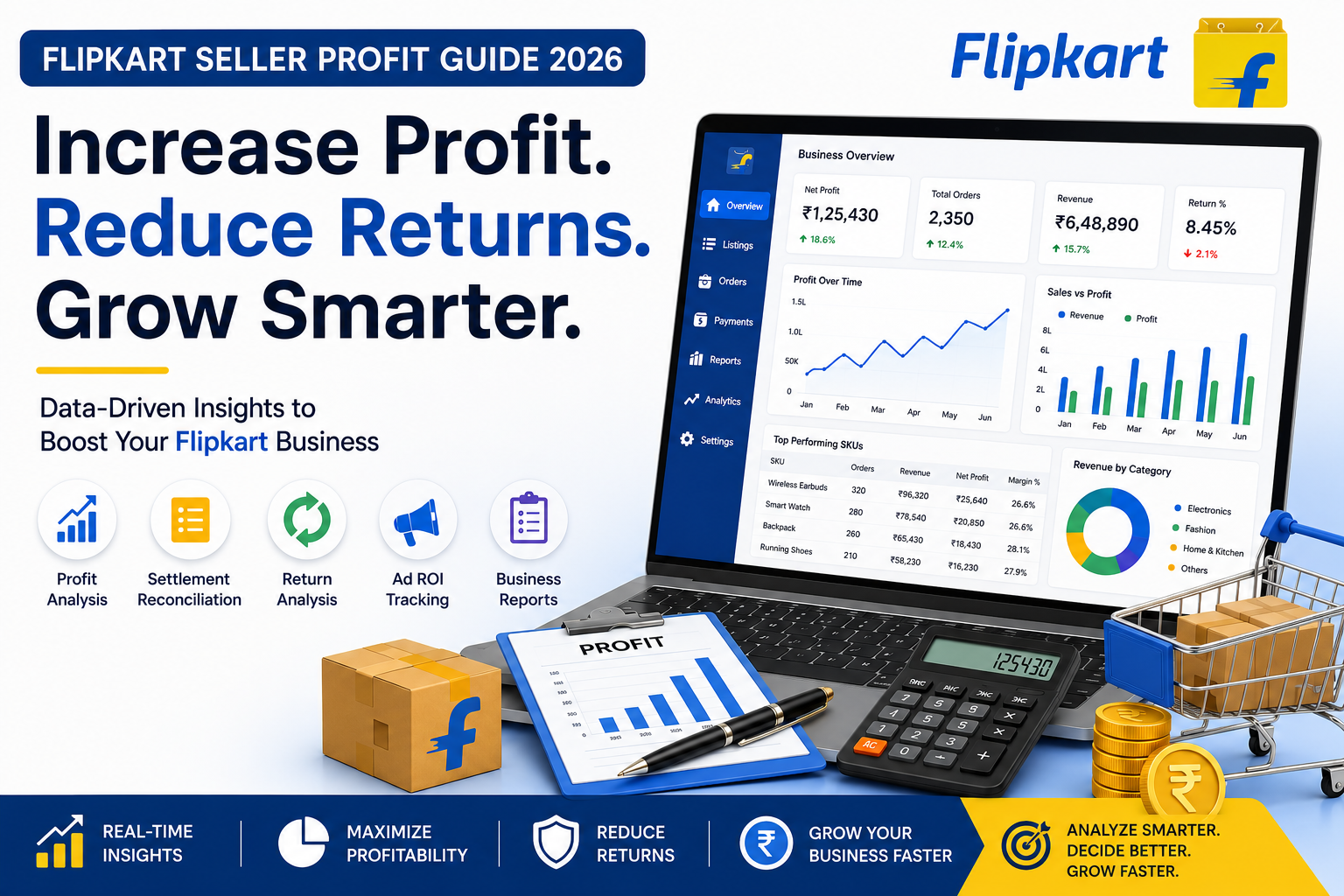
Flipkart is one of India's largest e-commerce marketplaces, offering businesses access to millions of customers across the country. Every day, thousands of sellers receive orders, dispatch products, and collect payments through Flipkart settlements.
But here's a reality many sellers discover only after months of selling:
High sales don't always mean high profits.
Many businesses generate lakhs of rupees in monthly sales but struggle to understand why their actual earnings remain low. Marketplace fees, returns, logistics charges, advertising expenses, and hidden deductions can significantly reduce profitability.
This guide explains how successful Flipkart sellers analyze their business, improve margins, and make data-driven decisions using advanced profit analytics.
Why Most Flipkart Sellers Don't Know Their Actual Profit
Many sellers track only:
- Total Sales
- Total Orders
- Bank Credits
Unfortunately, these numbers never tell the complete story.
Your actual profit depends on several additional factors:
- Product Cost
- Shipping Charges
- Marketplace Commission
- Collection Fee
- Fixed Fee
- GST
- TDS
- TCS
- Returns
- Reverse Logistics
- Advertisement Cost
- Packaging Cost
Without considering all these expenses, your reported profit is incomplete.
Understanding Flipkart Settlement Reports
Settlement reports are the financial backbone of every Flipkart business.
Each settlement contains valuable information such as:
- Order Payments
- Commission Charges
- Shipping Fee
- Reverse Shipping
- Collection Fee
- Fixed Fee
- Penalties
- Compensation
- Refund Adjustments
- TDS
- TCS
- GST Components
Instead of checking only your bank account, analyze every settlement to identify unnecessary deductions and improve profitability.
Common Hidden Costs That Reduce Profit
Many sellers overlook costs that silently reduce earnings.
These include:
Product Cost
The purchase or manufacturing cost of the product.
Packaging Cost
Courier bags, boxes, labels, tape, inserts, and protective material.
Marketplace Fees
Commission, collection fees, and fixed charges.
Returns
Reverse logistics, damaged products, and inventory losses.
Advertising
Sponsored products and campaign costs.
Inventory Holding Cost
Capital blocked in unsold stock.
Understanding these expenses helps you price products more effectively.
Why SKU-Wise Profitability Matters
Every product performs differently.
Consider the following example:
|
Product |
Orders |
Revenue |
Net Profit |
|
Mobile Cover |
900 |
₹5,20,000 |
₹38,000 |
|
Bluetooth Speaker |
250 |
₹4,80,000 |
₹92,000 |
|
Water Bottle |
650 |
₹3,40,000 |
₹19,500 |
The product with the highest revenue isn't necessarily the most profitable.
SKU-level analysis helps identify products worth scaling and products that require pricing or sourcing improvements.
Pricing Strategy for Flipkart Sellers
Never copy competitor prices blindly.
Before deciding your selling price, calculate:
Selling Price
Minus
- Product Cost
- Commission
- Collection Fee
- Fixed Fee
- Packaging
- GST
- Return Risk
- Advertisement Cost
- Miscellaneous Expenses
The remaining amount is your actual profit.
A sustainable pricing strategy focuses on long-term profitability rather than simply winning the Buy Box.
Managing Returns Effectively
Returns are one of the biggest profit killers on Flipkart.
High return rates increase:
- Reverse logistics expenses
- Product damage
- Repackaging costs
- Customer support workload
- Inventory losses
To reduce returns:
- Use accurate product images.
- Write detailed descriptions.
- Mention specifications clearly.
- Perform quality checks before dispatch.
- Improve packaging.
Even a small reduction in return percentage can significantly improve monthly profits.
Advertisement ROI Analysis
Advertising should generate profitable sales—not just more sales.
Track these KPIs:
- Ad Spend
- Orders Generated
- Revenue
- Profit
- Return Rate
- Cost Per Order
- Return on Ad Spend (ROAS)
Stop promoting products that fail to generate positive net profit after advertising costs.
Inventory Management
Efficient inventory management improves cash flow and customer satisfaction.
Monitor:
- Fast-moving products
- Slow-moving inventory
- Dead stock
- Reorder levels
- Inventory turnover
Maintaining optimal stock levels reduces storage costs while preventing lost sales due to stockouts.
Marketplace Reconciliation
Settlement reconciliation ensures every order has been accounted for correctly.
Benefits include:
- Detecting missing payments
- Verifying deductions
- Matching orders with settlements
- Identifying pending claims
- Improving financial accuracy
Regular reconciliation helps prevent unnoticed revenue leakage.
Build a Flipkart Seller Dashboard
A professional analytics dashboard should include:
Sales Dashboard
- Revenue
- Orders
- Average Order Value
- Daily Sales Trend
Financial Dashboard
- Net Profit
- Marketplace Fees
- Packaging Cost
- Advertisement Cost
- Tax Summary
Product Dashboard
- Top SKUs
- Low Performing Products
- Return Percentage
- Gross Margin
Settlement Dashboard
- Settlement Received
- Pending Payments
- Claims
- Recoveries
- Deductions
Common Mistakes Flipkart Sellers Make
Avoid these costly mistakes:
- Tracking sales instead of profits
- Ignoring settlement reports
- Underpricing products
- Not analyzing SKU profitability
- Poor inventory planning
- Manual spreadsheet calculations
- Ignoring advertisement ROI
- Failing to reconcile payments
Why Automation Matters
As your business grows, manual analysis becomes increasingly difficult.
Managing multiple reports every month consumes valuable time and increases the possibility of errors.
Automation enables sellers to:
- Save time
- Improve reporting accuracy
- Detect hidden losses
- Make faster business decisions
- Scale efficiently
How Profecom Helps Flipkart Sellers
Profecom is built specifically for Indian e-commerce sellers who want clear visibility into their business performance.
Our analytics platform transforms marketplace reports into actionable insights.
Features
✔ Flipkart Settlement Analysis
✔ Profit & Loss Dashboard
✔ SKU Profitability
✔ Return Analysis
✔ Advertisement ROI
✔ Inventory Insights
✔ Marketplace Fee Analysis
✔ Tax Summary
✔ Business Reports
✔ Interactive Dashboards
Whether you're processing hundreds or thousands of orders every month, Profecom helps you understand exactly where your profits come from—and where they're leaking.
Final Thoughts
Success on Flipkart isn't just about increasing orders.
It's about understanding your numbers.
Sellers who analyze settlements, monitor SKU performance, reduce returns, and automate reporting consistently outperform those who rely only on revenue figures.
By adopting data-driven decision-making, you can improve profitability, optimize operations, and scale your business with confidence.
Ready to Discover Your Real Profit?
With Profecom, you can:
- Calculate true product profitability
- Analyze Flipkart settlements
- Reconcile payments automatically
- Track advertisement ROI
- Monitor returns
- Generate professional business reports
- Save hours of manual work every month
Grow smarter. Sell profitably. Analyze everything with Profecom.